Sound’s Body
I Sweat In Your Phone
 I know I look fetching with perspiration dripping down my face, eyeglasses sliding down my nose, abdomen puffing in and out like the bellows it is, and a four-foot wooden tube stuck in my mouth, which I lick with abandon to get the proper saliva quotient on a finicky piece of cane held in place by two miniature metal screws.
But as dashing as my fluid fingerwork looks in 1080p HD, the sound is kind of important too. Between the amplification, the reflective acoustic, the talkative crowd, and the recording quality of your phone . . . well, you get the picture.
Then there’s me. At 80ºF plus humidity, the lower register of my flute refuses to speak—that is, when it’s not sliding off my chin. Tuning is a pipe dream (no pun intended).
Have you tried focusing on the feet? They’re the most musical part of the body, anyway. Though they might distort your audio quality.
I am alternating between four different instruments, and thus can’t fully warm up any of them; I mean, they’re overly warm, but not warmed up. My licorice stick is thirty-two years old. That’s 150 in people years. This species of wood is depleted, so I try my best to keep her going with hospice care as long as I can. Even so, at any moment she could explode in a spasm of uncontrollable asyntactic modernist squeaks. Fasten your seat belts . . . and there she goes! I hope that did not make your ears bleed. Or break your iMicrophone.
Is there a clarinet doctor in the house? No? But there’s an expert leatherworker? Hmm, an interesting possibility, but I think I’ll wait.
Sinuses. Arthritis. Insomnia. Not enough coffee. Too much coffee. PMS. Plus a run-of-the-mill cluster of neuroses. And I left the beta blockers in my other case. Actually, I think they’re in your case. Are they good? Should I get some? I’ve always been afraid to try them.
I’m furious at my duo partner and am glaring at him. We had a fight on the way to the gig. Not true, but it could be. For some other person, that is. Not me. Meantime, I do not want to miss when he winks at me between jigs, or when his eyes widen in surprise at my choice to play Mixolydian when he expects Ionian. He needs to be undistracted, so he’ll notice when I bounce in my chair to urge him to go twice as fast, or twice as slow, to accommodate the state of my lungs. (See above about sinuses, coffee, neuroses, etc.)
It’s a gymnasium, festive. Free-range kids running around screaming with glee. Throngs line up and jostle one another to thrust their tips in our expectant guitar case. Was that you who left the jalapeño croissant? (I am not making this up.)
As you see, it takes devotion and complete concentration to deliver the level of performance that passersby will want to keep as a souvenir. When you aim your phone at me, my performance ceases to be worthy of capture. Even Benedict Cumberbatch agrees.
Take away my comfort in knowing that these moments are ephemeral, and I fly without a net.
So, while I am honored that you want to carry me off in your pocket,—very honored, believe me—I am not ready yet. I want to look and sound my best before we take that step.
See that stack of business cards over there? Take one, and come see me next time. I’d love that! How my haircut will hold up until then I can’t predict, but I’ll sound much better than I do in that .m4v, I promise. And maybe a little later, when I’m ready, you can take me home with you.
—Barbara White
Looking for a date? Try some syncopation.
As a result, women may be expected to show heightened sexual preferences during peak conception times for men [sic] that [sic] are able to create more complex music. (Charlton, B. D. 2014, “Menstrual cycle phase alters women’s sexual preferences for composers of more complex music,” Proc. R. Soc. B 281: 20140403, p. 1).
Let’s begin with a question: Which of these gents:

—has the best genes?
Or, moving closer to our own historical period, which of these guys:

would make the best long-term partner?
Fortunately, now we have a way of finding out. A scientific one. Benjamin Charlton has completed a penetrating and fruitful study—the first, to his knowledge—that offers “empirical support for the sexual selection hypothesis of music evolution by showing that women have sexual preferences during peak conception times for men that are able to create more complex music” (Charlton, “Menstrual cycle phase,” p.1). It’s been written up in The Atlantic, where Cody C. Delistraty builds on Charlton’s research to posit that Liszt “was arguably the first to figure out how attractive musicianship can be.”
The musical examples in Dr. Charlton’s study were created in GarageBand™ and were provided to 1465 female test subjects in MIDI format. (That is, the musical examples were in MIDI format; the subjects were in their usual analog state and were instructed to dress as they would for a night out seeking male companionship.) The first, simplest, one begins with a couple of chords in 4/4—specifically, two quarter notes of G in second inversion, doubled in right and left hands of the GarageBand™ Grand Piano—which move up, for beats 3 and 4, to F in first inversion. (Also quarter notes, also doubled, all as before.) This measure of the composition is repeated 3 more times; then, the quarter notes are augmented to half notes, and we have, therefore, a bar of G 6/4 (two half notes) followed by a bar of F6 (ditto), with an attack every two beats. Then—you might want to sit down for this—those two bars repeat. Do you follow? Are you feeling turned on yet? (By the composer, I mean—not by me!) Well, just you wait! Next, the left hand plays the G chord again, but the right hand doesn’t! It enters (hmm) a half beat later and introduces a syncopated scalar motive, ascending through an entire measure. Herewith my reduction:

Remember, we hear that alternation from G6/4 to F6 eight times, and each iteration of each chord is inverted. There is no root position chord to reassure us of our independence and stability. Moreover, as above, the rhythm changes from quarter notes to half notes. There is another very erotic rhythm at the end—NSFS, I fear. But you can see above the suggestive spacing of the final chord.
The other three, increasingly complex, levels are variations on this same material. To my ear, it is all complicated, because the compositional material remains deceptively simple even as it grows more and more complex. The material doesn’t really engage with musical syntax but is more a string of stimuli, and it becomes overwhelming in the most sexual way: it’s just like being in a club and breathing in pheromones without understanding what is being awakened in your most primitive self. How to choose? I mean, really, look at the cornucopia of breads below: which one do you think would give you the most enjoyment for an evening? And sustenance for long-term health?

(I did not notice any identification of a composer in the study, though I may have overlooked his [?] name. I could also imagine he would want to protect himself from unwanted attention now that his work has been exposed to the public.)
Anyway, it’s not until the third most complex example that we hear a root position harmony—and there are two in a row, going right from A major to F major, still doubled in both hands, so we have six fingers (three pitch classes) moving downward in the same direction—each one traversing a third! It’s pretty sly, to give us the root position, but only with “parallel everything,” as we sometimes point out to beginning students. (This is the sort of prank that got Debussy thrown out of the Conservatoire—but he showed them!) This progression creates a mix of comfortable familiarity and transgressive tension that makes one want to meet this composer and get it on. Only a stump could fail to be titillated by such a caress.

Now, continuing on, a spoiler alert: the fourth and most complex example has harmonies that rub up against one another, as a sixteenth-note A chord sounds in the right hand before the left hand catches up . . . it lingers behind, fetchingly, on G. This coy dance of darting ahead, falling behind, and occasionally coming together reminds one of those R-rated scenes in Mutual of Omaha™’s Wild Kingdom.

(A composer/performer would of course be the fittest to display this prowess, for he would know best how to pedal to show off the mischievous foreplay here.)
There is also the flirty root movement of a tritone, in regard to which I can only invoke George Bernard Shaw’s commentary on the closing to Act I of Die Walküre: the music “is brought to a point at which the conventions of out society demand the precipitate fall of the curtain.” And so, I shall keep mum for propriety’s sake. (Regrettably, there is also insufficient time and space here to investigate the unexpected and provocative appearance, after so many inverted triads, of a quartal harmony. One suspects a revisionist history of Hindemith’s private life is forthcoming.)
Continuing on then, to examine the complexity of this fourth example, most seductive of all is this harmony:

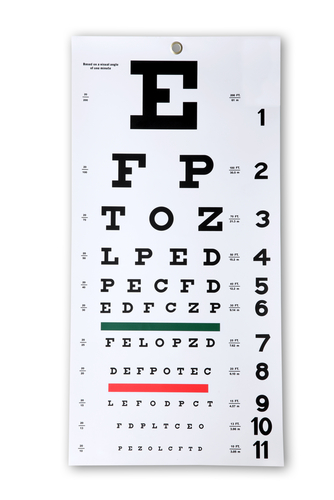
Following upon the by-now familiar, but (in this most tantalizing fourth example) mischievously syncopated G6/4, D6/4, G, and A, we suddenly hear this dizzyingly complex triad. It’s gripping. I misread it at first, thinking it was another D chord (with the A# an F#), moving entrancingly from second to first (!), but no—its a, well, you know—it’s that one. (Sorry, I just always feel a little funny saying it out loud.) Honestly, if I had been one of Dr. Charlton’s test subjects, I would have found it difficult to choose among all these eligible sonic stimuli. It’s a little bit like trying to decide which line in the optometrist’s chart would make the most appealing companion:
But if I am to admit to my most primal, procreative urges—which I’d better do soon, because the clock has no plan to stop ticking—I must agree that the most complex one, Bachelor No. 4, would win in the end. It’s just that—that je ne sais quoi of the A-sharp, which itself has a bit of a sophisticated Parisian tinge to it. It gives me the feeling that I’ll never understand the composer who conceived of it, and this, of course, makes him all the more alluring.
(Is it getting a little hot in here? Or is that just the clock ticking?)
It’s hard not to feel for the wallflowers toiling away at their simple music, seeing the most Lisztian composer go home each night with a new ovulating lady. But there is a silver lining for the modest: the ladies who listen, it turns out, hit on the composers of complex music for quick encounters only, aiming to breed, but not to forge long-term relationships. Thus the real usefulness in this study is for the gents—those who desire ladies and are looking for one (or more). The lesson seems to be the following:
- If you seek a fun fling, you will need to work very hard in order to develop the sort of composition chops that will attract the ladies to your DNA. But don’t expect to see her, or any resulting progeny, again; she’s just looking for a quickie and a deposit to satisfy her maternal needs. Since these will all be brief meetings, though, you will be able to re-use your portfolio and program on each lady you desire.
- If you prefer to take long walks on the beach, file joint taxes, cook lasagna for five, and snuggle, well, no need to worry so much about the working hard part. You’re already poised to attract a long-term listener/partner with your half notes. In fact, if you compose too well, you might find yourself approached by the wrong sort; and I’d hate to see you get hurt.
The two available objectives certainly sync up with the priority-setting and time-management required to foster them—which just shows that science, once again, has given music meaning and purpose.
If you would like more dating tips, you can purchase 30-day access to this study for only $29.25. (I am not making this up.) That’s thirty days, a couple of days longer than most women’s cycles, so it will give you plenty of time to bone up on your rhythm.
And if you would like a playlist to give you an idea of the typical childbearing-age lady’s—because this is all determined by our fluctuating hormones, you can count on a lot of shared interests—iPod cycle and help you warm up for your own masterpiece, see the list below.
I await further research on the use-value of my own (complex?) music. Meantime, having read the study—full disclosure: I was not at my most rational when I finished reading, as I am sure you will understand—I have begun to wonder whether experimental and analytical acumen, like compositional skill, occupy a special place in terms of sexual selection. Dr. Charlton, have you had a lot of response to your publication?
Copyright-free photos of historical composers from http://www.8notes.com.
Photo of blurry suited men courtesy of Princeton University Music Department.
Other images royalty-free from shutterstock.com.
For another response to the study and The Atlantic’s coverage, see Jonathan Bellman, “Romantic Power of Music, The.”
—Posted by Barbara A. White
 I Am Not Making Up

